Here’s to a Well Fueled, Inspired, and Optimized 2020!

By Robert A. Gilbert, CHME, CHBA, President and CEO, Hospitality Sales & Marketing Association International (HSMAI)

Happy New Year! I hope you had a wonderful holiday and are looking forward to an exciting, successful 2020. At HSMAI, our plan is to keep doing what we do, but even better. We remain focused on economic uncertainty as the biggest challenge facing our members — and committed to developing tools to help them navigate it. From events and certification programs to content and other resources, we will continue to elevate the hospitality industry in a way that fuels sales, inspires marketing, and optimizes revenue.

In 2019, we expanded our portfolio of offerings — which already included the Adrian Awards, the Marketing Strategy Conference, ROC, the CHDM and CRME certifications, seven Executive Roundtable programs, Curate, and the Insights and Executive Insights newsletters — with a new Sales Leader Forum, a new CRMA certification, a newly updated study guide for the CRME, a new line of HSMAI Special Report publications, and a new, HSMAI Foundation–produced CHRO Executive Roundtable.

Heading into 2020, we are better positioned than we’ve ever been. Our work is always determined by what our members need, and this year what they need will be influenced in large part by the economy — so tracking this moving target will remain a high priority for us. Over the last year we have devoted event programs and articles to economic forecasts and analysis, and that continues with this issue of Insights, which includes forecasts curated from a variety of trusted sources. My wish is that you find this information — and everything else HSMAI offers in 2020 — timely, relevant, and actionable.

4 Imperatives for Hospitality Sales Leaders

By Kaitlin Dunn, Writer, Hospitality Sales & Marketing Association International (HSMAI)

At HSMAI’s Sales Leader Forum on Nov. 5–6, Cindy Novotny, managing partner at Master Connection Associates and recipient of HSMAI’s Award for Lifetime Achievement in Sales, presented a keynote address on “Sales Imperatives for Today’s World.” Here are four key takeaways:

1. LEADERSHIP

“If you don’t like helping people, growing people, role playing with people, going out and making sales calls with them,” Novotny said, “then you really shouldn’t be a sales leader.” She also suggested that the reason people are leaving the industry is because of bad leaders, who hire without explaining the realities of the job first. “They’re not leaving the company, they’re leaving people,” she said. “You didn’t hire them right.”

2. BUSINESS KNOWLEDGE

As a sales leader, you have to know not just what customers need but what you can offer them that your competitors can’t. “You have to know your customer,” Novotny said. “You have to know their divisions. You have to know who they compete with, how you can get more referrals from them.” Indeed, Novotny noted, referrals from existing business are some of the best leads she gets and shouldn’t be overlooked or underutilized.

3. CUSTOMER FOCUS

Novotny shared that she constantly hears that hotels make it more difficult than it should be for customers — guests, meeting planners, travel agents — to do business with them. “Just answer the phone, talk to the customer, and then have a team that works on them and get everybody involved,” Novotny said. “Don’t make the customer work for this.”

4. ADVANCEMENT

No matter how big or small your team is, you need to be on the lookout for ways to elevate everyone working for you — because at the end of the day, you have to be able to show the numbers, and the numbers come from the salespeople on your team. “Those who say it can’t be done,” Novotny said, “better get out of the way of those who are doing it.”

5 Things to Know About HSMAI Lifetime Honoree Bjorn Hanson

Bjorn Hanson, Ph.D., has enjoyed a legendary career in hospitality consulting and education, and it all started with a trashy book: Hotel, by Arthur Hailey, which Hanson read when he was in high school in the 1960s. The world that Hailey described in his bestselling novel about a fictitious New Orleans hotel “sounded interesting,” Hanson recently told HSMAI, and prompted him to spend what today would be called a shadow day with a family friend who worked as the director of sales and marketing for Loews’ Americana Hotel — now the Sheraton Times Square — in New York City.

“After he spent a little time in the office telling me about his job, he took me into the front office and said, ‘I’ll come back in an hour or so,’” Hanson remembered. “It was a great first front-office experience, because this was before computers, so there was no computer reservation system. They had a 300-person convention not entered into the reservation book, so the hotel was overbooked by 300 rooms. My first day on the job was learning how to say to people, ‘We have no available rooms, but I’m authorized to give you $3.50 for cab fare for you to go to another hotel.’ So, I learned to not stand too close to the front desk.”

In the afternoon, the sales and marketing director took Hanson to another hotel — for a conference luncheon for the Hotel Sales Managers Association (HSMA, which today is HSMAI), where he met a group of hospitality students from Cornell University. “My first day working in a hotel,” Hanson said, “I had the worst front-desk experience one could have and the best HSMAI experience one could have.”

Eventually, Hanson himself attended Cornell, where he served as HSMA’s student chapter president, helping organize the school’s first-ever HSMA student conference. After graduation, he served as general manager of a hotel in northern New Jersey, but his true interests were finance and consulting, and he soon took a job as a hospitality consultant with Laventhol & Horwath, the major accounting firm that specialized in hotels. He stayed there for 17 years, moved to Wall Street to work in hospitality banking, then joined PricewaterhouseCoopers, where he founded the hospitality and leisure practice. After retiring in 2008, he promptly joined the full-time faculty at the New York University School of Continuing and Professional Studies, and two years later became dean of NYU’s Preston Robert Tisch Center for Hospitality, Tourism, and Sports Management.

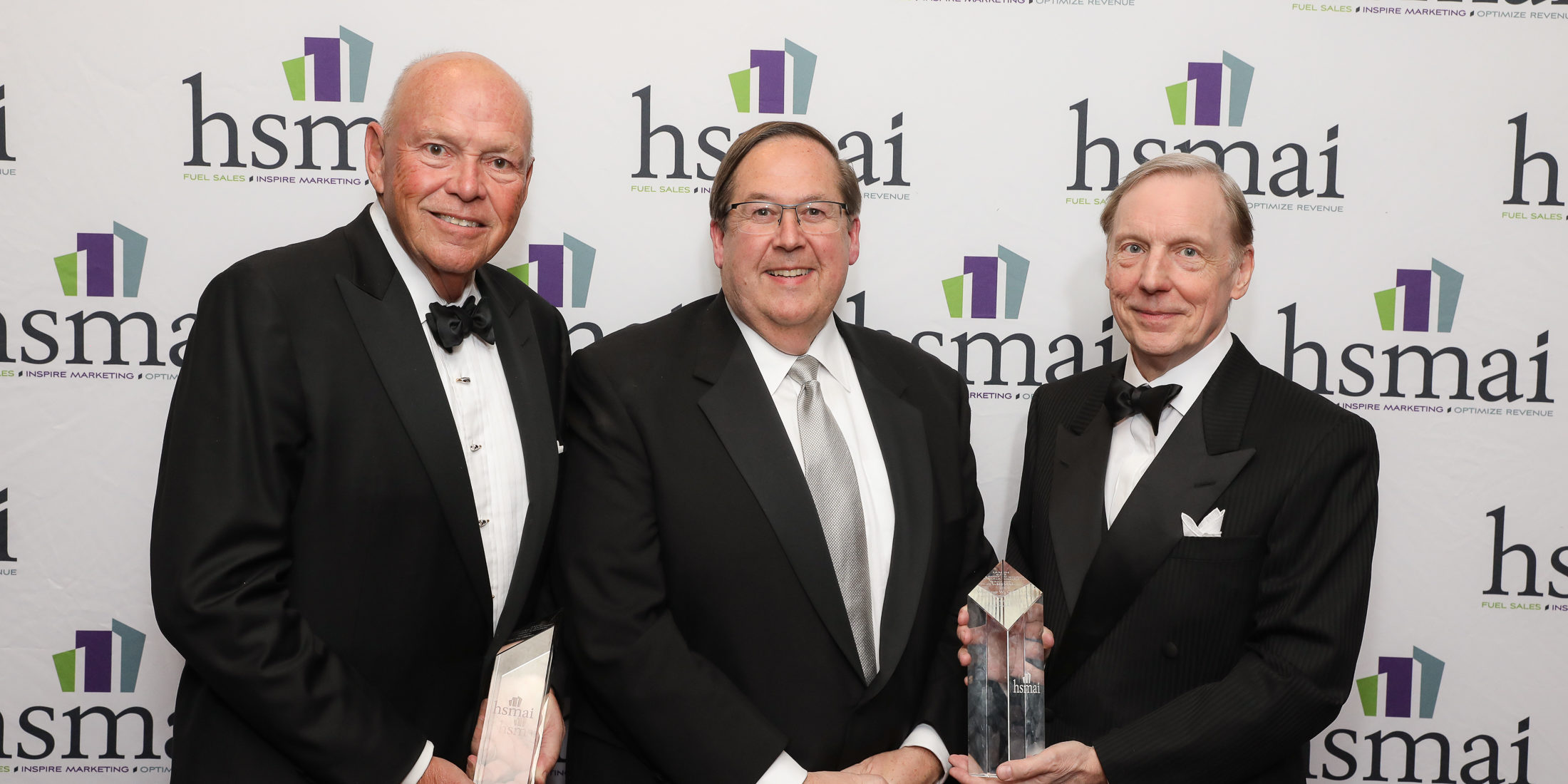
He retired from NYU in 2018, but nonetheless finds himself with two full-time jobs: executive director of the 795 Fifth Avenue Corporation, which owns The Pierre hotel in New York City, and member of the board of directors for Summit Hotel Properties, which owns 80 hotels. And he’s still not done. At the Adrian Awards Dinner Reception and Gala on Jan. 21, HSMAI will honor Hanson with the Winthrop W. Grice Award for Lifetime Achievement in Hospitality Public Relations — recognizing his status as an industry expert who has been quoted in countless newspaper, radio, and TV interviews. For Hanson, the award brings things full circle. “One of the people I had speak at that [HSMA student] conference was Bud Grice, and I’m getting the Bud Grice Lifetime Achievement award,” Hanson said. “To receive an award with his name means more than it probably could to almost anyone else. My career started with HSMAI, and here I am.”

Here are five other things we learned during an interview with Hanson:

1. He loves hospitality because it matters to people. “When I was trying to decide what to do when I was in high school, the thing about hotels for me was the theater of it —when you walk into a hotel, there should be an experience. But then, I’ve learned that hotels are so important in so many people’s lives. If it’s a business hotel and people are staying there for business, it might be someone’s first day on the job — they’re going to an orientation and training program, which maybe is being held at a hotel. If a group has been working for months on a new product announcement, it happens at a convention hotel. People’s retirement dinners and annual partner meetings — so much important business happens at hotels. And then in people’s personal lives, it’s wedding rehearsal dinners and wedding receptions and anniversary parties, and when people go on vacations and honeymoons and take their kids the first time to Disney World. This theater that I first associated with hotels became not so much theater but an opportunity to create some of the more important moments in people’s lives.”

2. He thinks the industry has changed for worse and for better. “The separation between ownership and management in some ways is sad. The person who wanted to own a hotel to be the host is rare. It still does happen, but it happens almost more at the economy level than it does at the luxury level. That person who wanted to be the host and run the business day-to-day, it’s become so much of a challenge, and I find that to be a bit of a loss. But the same thing that’s the bad also is the good. The business has become so much more sophisticated and able to deliver so much more because of the separation of ownership, management, and brand, because now we can have specialists whose career lives are based on knowing how to be the best owner and invest capital. And there’s a management company that knows how to do the day-to-day things, including book computer systems, revenue management systems, and property management systems, and how to recruit and train and retain people. And there’s the brand that knows how to create the image in the marketplace and gets involved in distribution. So, the same thing that I find disappointing also is one of the good things about the industry.”

3. He always wanted to teach. “My first day after graduation, it was a long-term objective. I graduated in 1973, in 1978 I started teaching at NYU, and in 1979 I became a visiting assistant professor at Cornell. It was something I wanted to do, and I have a couple of reasons. One is, my view of universities as an undergraduate was that the next level of education — master’s and Ph.D. — related to research, and we were an industry that I thought would benefit from the kinds of research that were being applied to other sectors of the economy. I also felt my experience at Cornell was truly lifechanging. It was such a positive experience for me to have those four years and feel like I learned new things that I could go out and apply, and the idea of trying to help others have that experience — to be part of that process, I felt it would be a positive life experience.”

4. He’s a hotel careerist. “This is an industry that has so many different channels. There are all kinds of jobs — ones where you’ll interact with people, ones where you won’t interact with people, ones where you can go home after work and not even think about what you do during the day, and others where you can apply your greatest creative talents and make things happen. You can be in a hotel, you can be in a corporate office, you can do what I did, which was consulting with one of the major accounting firms or working on Wall Street. If you find you really like food, there’s a place to go, or if you find you’re really interested in advertising, hotel advertising is a unique specialty. It’s one of those industries that creates more ways for someone to find his or her way to have an enjoyable career. I can’t imagine there are too many that are better or more flexible or offer more opportunities.”

5. He is a nontraditional PR person. “I’m not a CEO of a company who gets quoted in the company’s public relations. I’m more of an industry researcher and analyst who just had the opportunity to talk about the industry more than many people do. Even though I’m semi-retired in some ways, it’s rare that I don’t have between three and seven media interviews a week. I think it’s just the fact that my passion and interest and excitement for the industry make me quotable.”

The Once and Future History of Distribution in 5 Parts

For most of her long and accomplished career, Flo Lugli, founder and principal of Navesink Advisory Group, has worked at the intersection of hospitality, travel, and technology. During that time, she has seen distribution become perhaps the defining issue of hospitality industry disruption, with everyone from hotel companies and technology platforms to OTAs and tour operators struggling to understand and master this shifting landscape.

On a recent call for HSMAI’s Faculty Roundtable, Lugli presented an overview of distribution, from its history, to its evolution across platforms, to its convergence with revenue optimization and marketing. Here are excerpts from her presentation:

1. THE DAWN OF DISTRIBUTION

In the beginning, it was all about the GDS [global distribution system], and there was a focus on connectivity: How do we manage and connect and provide our rates, availability, and inventory out to the GDS? This is around the mid-’80s, once Sabre and Galileo came out with a new hotel platform. In most cases, it was managed by database teams that lived within a central reservation call center. This was also around the time that you had the launch of companies like THISCO, WizCom, and Lanyon to help hoteliers distribute their rates, inventory, and content. There were a few direct-connects at the time, but as the new hotel platforms came out, it was more and more difficult for the hotel companies to support those direct-connects, and so it was really THISCO and WizCom that were driving most of that connectivity.

At the time, content was — and quite frankly it still is — a challenge for the industry. When I was running WizCom, we were trying to address the issue of content management. With the five GDSs at the time, you would literally have to load properties and all of their rules and policies and room information and local information five different times. I developed something called Easy Access Plus, which basically created a switch for content, but it was very limited. It was very focused on the GDS. There were a limited number of fields that the GDS actually supported. And of course, with the advent of the internet and widespread distribution, it certainly wasn’t designed for consumer-friendly type of content.

As the internet evolved — I’m talking around mid-’90s to mid-2000s — brand.com efforts were managed separately from other third-party efforts, such as OTAs. So, you had a group of folks that were focused on brand.com, and then you the distribution folks, still primarily driven by database and connectivity people, managing the third-party relationships. After 9/11, as business dropped and the OTAs started to play a much more visible role in hotel distribution, the hotel industry began to think about how to better manage their distribution needs.

From around 2005 on, metasearch players — TripAdvisor, Kayak, Google — started to play increasingly important roles. Hotel companies began to assess what their organizational structure should be between distribution and commercial. There were a lot of conflicts between the brand.com department and the distribution department. Brand.com wanted to drive more business to the brand websites, and distribution wanted to drive more business to the OTAs. There was this internal conflict that needed to be resolved.

2. GETTING SERIOUS ABOUT DISTRIBUTION

As we moved into the first half of this decade, obviously OTAs continued to get stronger, as did other third parties, such as Google and TripAdvisor. As the hotel industry started to get more serious around distribution, it began to become a topic in the executive suite. Hotel companies ramped up their investments in brand.com and mobile sites. For example, when I joined Wyndham [as executive vice president of marketing in 2009], we undertook a $100-million capital investment in technology — digital, mobile, and so forth.

The conversation at the time centered around “The OTAs are the enemy.” Rate parity started to get a lot of attention, and Roomkey was formed in an effort by the major hotel companies to try and gain a little bit more control over their distribution, and perhaps to provide a little bit more leverage in their negotiations with the OTAs, although that was never an admitted goal. And then, of course, channel managers became more and more important. As more third parties came into the mix, it was becoming increasingly difficult, especially for independent hotels and small chains, to manage their distribution.

This was during the time when hotel companies aligned distribution under commercial. The execution of managing the connectivity and perhaps the database components of distribution still resided under the call centers, because that’s where most of these people were located, but the actual strategic development and plans were moved under commercial. There was a lot of education going on within the hotel companies about distribution and its implications and complexity, but I don’t think most people in the C suite really understood how complex it was — the need for multiple connections, how to distribute content, and so on.

As we fast-forward to the past four or five years, distribution has become front and center in most discussions. It has become much more commercially focused, but there remains a technical and operational component that must be understood and actually managed. You obviously have more and more investment in brand.com mobile and book-direct campaigns, as an example. And then, beyond book-direct, hotel companies are now saying it’s less about discounts and more about customer engagement, and OTAs have moved for the most part from being the enemy to being the partner. Hence, as an example, the recent Marriott deal with Expedia.

3. THE DISCIPLINES AND DISTRIBUTION

Organizational realignments continue, and revenue management has moved to focus on revenue optimization. Heads of marketing have evolved to roles that are more chief commercial officers or chief revenue officers, depending upon the hotel company, and there’s been a real focus on how to optimize revenues. There’s also been a renewed effort to understand channel costs and optimal channel mix, because distribution is really about understanding what does it actually cost me to get that sale.

For me, distribution today is about how hotel product can be sold to consumers. And when I say “hotel product,” I don’t necessarily mean a room, I mean any service or amenity within the hotel. That could be the swimming pool, or the cabanas, or the meeting rooms and the restaurants, and so forth. It includes all channels — not just GDS and third party, but brand.com and voice, and even to some extent direct to the local property. It also includes all disciplines. Distribution isn’t just focused on how do I make that connection and how do I get that content out there, but it needs to be thought of throughout all disciplines: marketing, loyalty, sales, revenue management, and technology. Everybody needs to be aware of how ARI and content is distributed and the costs thereof, so that they can create a much broader channel-mix strategy.

To summarize, distribution is the overarching strategy of how a hotel or a hotel brand actually markets and sells, with a true understanding of channel costs and ROI. One of the biggest challenges in understanding channel costs and ROI, quite frankly, is the chart of accounts that the industry uses, where you have different departments tracking different costs of distribution. In the reservations department, you have the res fees, and in SG&A, you have the credit-card fees, and in marketing, you have some of the distribution fees. But it’s really difficult for an individual hotel to pull all of those together and understand true cost of distribution.

4. THE CHALLENGES OF DISTRIBUTION

There are other unique challenges within the hotel industry. The fragmented structure masks the real cost of distribution, and the fact that you have local-level decision making on what rates you’re going to offer and what inventory you’re going to offer complicates things. Can you imagine if there were an airline that was franchised, where every single plane was owned by somebody different, and they decided where they wanted to fly and what they wanted to charge? There’s also a lack of consistent technology investment across the industry. The brands are making some investments, but the hotel owners generally don’t have the money, and certainly the management companies are not usually incentivized to make those investments.

This industry is overly dependent upon content. Consumers want to see videos. They want to see photos. They want to really understand what the experience is at the hotel versus the kind of content that you need for an airline seat or even a rental car. The leisure skew plays into the strengths of the OTAs, who have billions of dollars to spend and who have very strong consumer brands. And then, of course, we’re highly dependent on Google and metasearch for customer acquisition. Another of the biggest challenges in the industry today is that the cost of customer acquisition continues to rise.

5. REVENUE OPTIMIZATION, MARKETING, AND DISTRIBUTION

From a revenue management, revenue optimization perspective, what we’ve started to see is a real focus on driving a revenue management culture and approach throughout the entire business — getting people to understand exactly what do we mean by revenue management, why is it important, why digital marketers need to talk to revenue management before launching any promotion. Again, understanding the real costs of each channel and the ROI is important, because brand.com is not free and, in many cases, can be the most expensive channel for owners when you factor in discounts, PFP fees, and the amenities they need to deliver for loyalty. In some cases, it could be more expensive than an OTA booking. So, I think it’s important for revenue management to take the lead in driving better organizational alignment and collaboration across the enterprise and make sure that incentives are aligned, because what gets measured gets done.

Last year I completed a nine-month engagement as interim chief commercial officer for the Americas for Radisson, and one of the things that we did while I was there is build a strong collaborative environment between marketing and revenue management. There were weekly meetings to talk about things like need periods, what kind of offers should we give, what were the results of those offers, how long should they run, what should we test. And there was a lot of effort around understanding, when we did do a promotion, what was the actual ROI on that? We looked at not just how much it costs to place the ad and what was the revenue that was generated, but also what were some of the other costs that went into that promotion?

It’s tough to undarstand ROI for branding exercises. The old marketing saying goes, “I know that only half of my marketing works. I just don’t know which half.” There are ways to look at branding exercises and branding spend versus revenue-driving efforts by doing some cross-channel analysis — when you’re doing some branding efforts, whether that’s radio or TV or whatever, tie that to did we see a spike in call volume and did we see a spike in visits to the website.

So, in summary, over the last 30 years, distribution has moved from an operational and technology focus to a commercial focus, but understanding the operational, technical issues and the cost is important to help define what that optimal channel mix should be for an organization. Organizational alignment and collaboration has never been more important or more critical to optimizing revenue.

Research in Action: Total Hotel Revenue Management

By Kaitlin Dunn, Writer, Hospitality Sales & Marketing Association International (HSMAI)

At HSMAI’s ROC 2019 event in June, six college and university faculty members from hotel schools across the U.S. and Canada presented research in areas related to revenue optimization in the hospitality industry. During one of the presentations, Dr. Gabor Forgacs, an associate professor at Ryerson University’s Ted Rogers School of Hospitality & Tourism Management, discussed his research “Total Hotel Revenue Management,” which focuses on current practices and future trends of total revenue optimization in hotels.

Working with Starwood Hotels & Resorts Worldwide’s Alice Zheng, Forgacs conducted in-depth interviews with a dozen industry leaders, academics, and revenue professionals, questioning them on their knowledge of total hotel revenue management and its use at properties. The research found that there is a growing awareness and strategic direction to embracing total hotel revenue management and gradual progression at the property level. However, the research also found that there are identifiable impediments to implementing it, including:

1. A lack of revenue personnel with experience and qualifications. According to a summary of Forgacs and Zheng’s research, most interviewees were concerned about whether will be sufficient revenue professionals to practice total revenue management in the future.

2. Technology challenges. The most pressing issue with regard to technology is the management of multiple revenue streams — particularly the seamless interfacing of data between systems.

3. Departmental conflicts. Departmental silos impede the alignment of objectives and incentives as well as a clear reporting structure for who has the final say in rate, inventory allocation, etc. According to the summary of the research, interviewees agreed that while the final decision maker on pricing and group sales should be the revenue manager, director of revenue, or general manager and that the revenue manager should have more authority than a sales manager, there are still hotels where the revenue management department reports to the sales and marketing department in the chain of command.

4. Organizational culture and employee education. Forgacs said that a lack revenue culture and a need for training to operationalize corporate strategic goals are two areas in which hotels can improve to achieve success with total hotel revenue optimization.

The Power of Proactive Selling

What do you do when you’ve spent the last 10 years taking inbound leads for granted — and you’re facing the possibility of an economic slowdown? Pivot to proactive selling. A new white paper from HSMAI and Knowland, Finding the Right Group Business, explains how. Read an excerpt below:

While meeting and events are among the many sectors that have benefited from a robust economy over the last 10 years, offering hotels a brisk pace of business and relative ease in making their group sales targets, signs now point to an inevitable slowdown in the U.S. hotel industry. Occupancy, ADR, and RevPAR have all grown in 2019, for example, but the numbers are below previous projections for the year. And with an over-supply in new-hotel construction creating a glut of rooms, the group sales process could become quite a bit more difficult. Hotels realize that their current group strategy, with salesforces simply trying to keep up with an onslaught of inbound requests, might not be up to the challenge.

With this nearly decade-long strong economy “we find that our sales approach is far more ‘catch and close’ versus prospecting,” said Lori Kiel, chief revenue and marketing officer for The Kessler Collection. This has meant that her team has had to travel less and deploy more of its resources responding to inbound leads. But the tides are shifting, and Kiel is already seeing a slowing in transient demand in 2019. “We have moved our group mix up at all of our hotels to make up the difference,” she said.

So why hinge success on market conditions? Why not set up your hotel to outperform the competition in all economic times? To do that, you need a proactive group sales strategy. Selling group directly and proactively is a paradigm shift in which salespeople pivot from simply focusing on third-party inbound digital leads to putting resources toward fostering a direct-to-planner business source. This strategy brings relevant groups to the forefront for hotels to reach out to directly, closing gap dates, boosting repeat business, and optimizing profits.

But getting to that point takes deliberate effort, in part because handling inbound lead volume is already a time-consuming activity. The advent of eRFP platforms has given hotels a seemingly bottomless source of leads. While such tools “have given us a platform to reach meeting planners without leaving the offices,” Kiel said, “the question to be asking is: How well are those leads converting and at what cost?”

Sales leaders are beginning to question whether they have the right sales strategy for long-term success. Hotels won’t simply be able to flip a switch to a proactive sales strategy once the economy has already turned, so it’s vitally important to invest in these changes now. Is your team trained up? Do you have the right solutions in place to enable this strategy? What do you need to do to support proactive selling — and are you even measuring the right outcomes?

Marketing Evolution – Attribution and Analytics Best Practices from the Field

By Debbie Howarth, Ed.D., Professor, Johnson & Wales University College of Hospitality Management, and a member of HSMAI’s Marketing Advisory Board

As part of a project to update HSMAI’s Certified Hospitality Digital Marketer (CHDM) study guide, HSMAI’s Marketing Advisory Board (MAB) recently discussed best practices for data analytics, attribution modeling, marketing skills, and more. Here are three takeaways from our conversation:

1. The role of hospitality marketing professional is constantly evolving. Many of the MAB members on our call offered different ways the role is changing, but all agreed that marketing professionals today need to know more and different things than marketers in the past. It is more than just learning and applying the new attribution or analytical tools. “Folks have to be scrappier than they used to be,” one MAB member said. “If you look back 20 years, there’s a lot of people who got stagnant and stuck in knowing what they know and not knowing what they didn’t, but today it’s different.”

Another member noted that the lines between the disciplines increasingly are becoming blurred. “In order to do the job, you need to understand what’s happening in operations and revenue management,” the member said. “You need to understand how they’re putting out rates and how you can develop that into a marketing campaign or even just have it on your website in a way that will get bookings.”

2. The scope of marketing analytics differs at the property vs. corporate level. An MAB member from a hotel management company sees more focus on marketing from a brand level, which can lead to conflicts at the property level in terms of where the money should go and who carries the cost. Meanwhile, an MAB member from an independent property struggles with doing everything on their own, including where to spend on marketing.

“I struggle with the feeling that if we were to only look at attribution modeling, we would put all of our money into digital and take everything out of any other traditional marketing avenue,” the member said. “Because it’s untrackable essentially, so it’s a lot of trying to grapple with my own convictions on things and with how much of the budget we should spend in those different areas.”

3. Different attribution models work better for different companies. One MAB member said how you calculate the numbers depends on what system you’re using for tracking. Another said it depends on the nature of the client and what their business goals are, which informs them how to make a marketing investment.

Another MAB member uses multiple attribution models and looks at the same data through several calculations. “We don’t believe that any attribution model is going to give you a precise number that you can take to the bank,” the member said. “We just think it’s a tool that helps us trend in and compare different campaigns to each other. So that’s why we kind of look at it from multiple lenses and have discussions about what each one means.”

To learn more about HSMAI’s  Certified Hospitality Digital Marketer (CHDM) credential, click here

Research in Action: Morality in Decision Making

By Kaitlin Dunn, Writer, Hospitality Sales & Marketing Association International (HSMAI)

At HSMAI’s ROC 2019 event in June, six college and university faculty members from hotel schools across the U.S. and Canada presented research in areas related to revenue optimization in the hospitality industry. During one of the presentations, Dr. Jeffrey Beck, associate professor in Michigan State University’s School of Hospitality Business, discussed his research on “The Role of Individual, Organizational, and Moral Intensity Factors on Revenue Manager Decision Making,” which focuses on how revenue optimization professionals respond to certain situations. The premise of this research, Beck said, was that “revenue managers and those responsible for the revenue management function are the most sensitive to ethical situations,” or that they are more attuned to recognizing situations and judging them as being ethical or unethical.

Background: Beck gave research participants — a mix of hospitality professionals — a series of scenarios that revenue managers may face and asked if they thought the situation described was an ethical problem, if the revenue professional should do the proposed action, and if the participant would do the proposed action if he or she were in the scenario. They were also asked about the harm caused by the action and if most revenue professionals would agree the action is wrong. Seventy-seven percent of those surveyed had a code of ethics in place at their properties, while 23 percent did not

Of the participants, 28.2 were on-property revenue professionals, 13 percent were regional or cluster revenue professionals, 2.28 percent were RM consultants, 7.8 percent were sales managers, 37 percent were owners or general managers, and 12 percent described themselves as “other.”

Scenarios: Beck presented to the ROC audience a few of the scenarios he gave to participants, including one involving a revenue professional who was asked by the general manager to instruct staff to quote a higher rate to guests who walk in without a reservation in the hopes of reaching the period’s revenue goal; if the guest resists, the staff will offer a reduced rate, still higher than the quoted rate on other channels. Sixty-eight percent of participants said that the situation was an ethical problem, 71 percent did not think the revenue manager should follow the GMs instructions, and 79 percent said they personally would not do what the GM instructed them to do. Thirty-three percent of participants thought the overall harm as a result of the action would be small, 50 percent disagreed thought the overall harm would not be small and 17 percent were neutral, while 68 percent believed that most revenue professionals would think the action was wrong, 19 percent said they did not believe most revenue professionals would think the action was wrong and 13 percent were neutral. Twenty-three percent believed the action would not cause any harm in the immediate future, 60 percent said the action would not cause any immediate harm and 17 percent were neutral.

Takeaways: According to Beck, prior research indicates that codes of ethics specific to revenue optimization impact ethical-situation recognition, judgement, and intention.

Legal Issues for Sales Professionals

By Kaitlin Dunn, Writer, Hospitality Sales & Marketing Association International (HSMAI)

At HSMAI’s Sales Leader Forum on Nov. 5–6, hospitality-law expert Steve Rudner presented a keynote address on “Headlines and Headwinds for 2020: Legal Issues for Sales Leaders’ Radars.” Here are four key takeaways:

1. GDPR

The European Union’s General Data Protection Regulation (GDPR) applies to any hotel that host an EU citizen. When group clients bring their own GDPR clauses to the table, it can be frustrating for hotels.

Rudner advises hotels to simply say they comply with the GDPR and say no to the additional clauses. He compared this to the Americans With Disabilities Act in that guests or organizations bringing in their own clauses, but by law, as long as hotels comply with GDPR or the ADA, they don’t need to go any further. “If your hotel company is compliant,” Rudner said, “you shouldn’t be saying anything more than you comply with applicable law.”

2. CONFIDENTIALITY

Companies would pay big money for information from rivals. When you sign a confidentiality clause with a group client, you’re saying that everyone in the hotel (all employees) and anyone that could get into the hotel (such as a reporter taking a paper from a trash can) will keep the information confidential. And that is nearly impossible to guarantee. “If you’re signing this confidentiality clause because you don’t think it’s going to be a problem,” Rudner said, “it’s going to be a problem.”

Rudner suggested talking it over with the organization and telling them what you can do as far as keeping their information safe, such as having guards at the doors and throwing away all handouts — without signing a clause that will hold you liable.

3. ATTRITION

Many hotels are changing the way they calculate attrition — shifting from a cumulative basis to a nightly basis. It doesn’t work if groups book a certain amount of rooms for multiple days but have more than that number some nights and less on others. Both groups and hotels need to stick to that agreement, so the situation works out for both parties.

“A group has always been expecting us to give them rooms on a nightly basis,” Rudner said. “There is no difference between us expecting a group to produce the number of rooms for us on a nightly basis. That’s what nightly attrition is about.”

4. ECONOMY

While nobody knows for sure how the economy will perform, Rudner noted that many observers are predicting an economic downturn next year. In times like this, he said, some hotels like to sign contracts with the promise of unlimited attrition or no cancellation fees, but Rudner warns against that.

“We’ve gone through enough cycles that we know empirically that it does not drive any better business to your hotel,” Rudner said. “There is nobody that’s going to come to your hotel because you’re waiving cancellation fees. What happens is your books get filled with a lot of tentatives that pretend to be definites.”

What’s on the Minds of Marketing Leaders?

By Juli Jones, CAE, Vice President, Hospitality Sales & Marketing Association International (HSMAI)

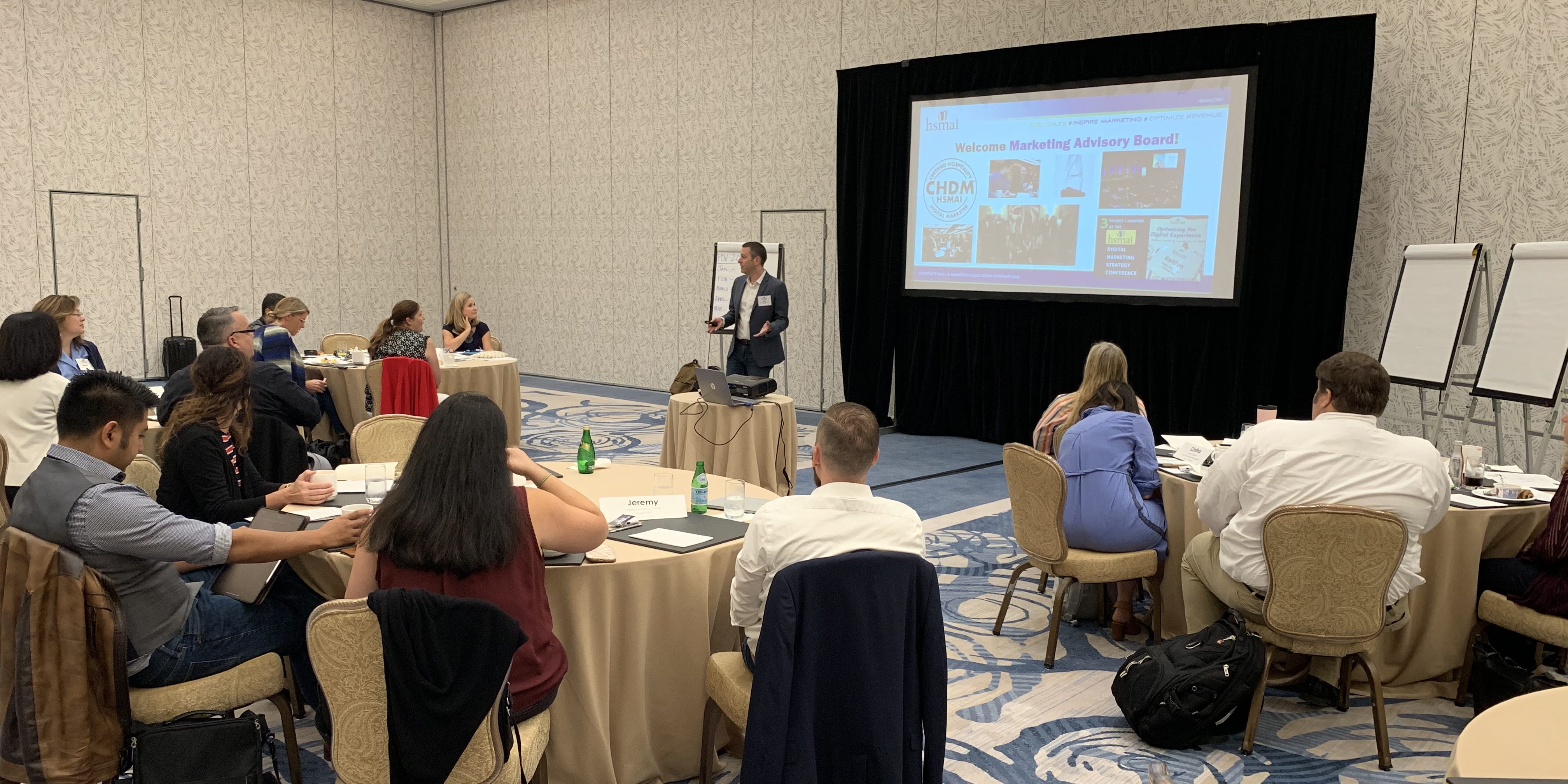
HSMAI’s Marketing Advisory Board (MAB) held its annual retreat last month to identify the most pressing issues facing hotels on the marketing front, and outline plans to provide marketers the insights, tools, and best practices they need to address them.

Marketing in a Digital World: While originally founded more than a decade ago to help the industry navigate the then new digital marketing ecosphere, today’s Marketing Advisory Board has an expanded scope, focusing more broadly on “Marketing in A Digital World,” as opposed to just digital marketing. So, in addition to tracking new issues on the digital front, the advisory board advises hotel marketers to broaden their own areas of focus as well.  Key aspects of marketing to stay abreast of on- and off-line include:

  • Public Relations
  • “Traditional” offline channels (e.g., in-hotel marketing, on-property collateral, print, TV, radio)
  • Loyalty
  • Branding
  • Experiential marketing
  • Social
  • Alignment with sales, revenue optimization, and distribution
  • Attribution modeling
  • Campaign tracking
  • Full-funnel media strategies
  • Integrated marketing
  • Local market-based marketing
  • Reputation management

Top issues and disruptive forces: What are the top issues and disruptive forces facing hotel marketers today? MAB members identified:

  • Competition that owns their own technology (like Airbnb)
  • Rate parity and meta (especially when it comes to Google)
  • Keeping up with governmental regulations
  • The economy — prepping for a potential downturn, and setting rates responsibly to protect brand and rate integrity
  • Getting to a precise calculation of ROI on marketing initiatives
  • Gen Z — adapting to and keeping up with them
  • The convergence and confluence of disciplines and stakeholders throughout the revenue generation, capture, and optimization cycle
  • Consumers’ consumption behavior when there are many, many channels from which they can choose
  • Consolidation via mergers and acquisitions on both the hotel company and technology partner fronts
  • Attribution modeling — being clear on what is being measured, having internal alignment, learning from other industries, and sharing best practices
  • Loyalty — friction/lack of convenience is a problem that hotels must overcome
  • Getting clean data — it is hard to get data you can trust when owners’ investments in technology and other related tools and initiatives are often short-term focused
  • Keeping good talent

Look for the Marketing Advisory Board to address these and other issues at the HSMAI Marketing Strategy Conference on Jan. 22 and in other initiatives throughout 2020.